MCS certificate
Registered by the installer once the system is commissioned. The grant depends on an MCS certified installation.
England and Wales · checked 3 November 2026
What happens at each stage of fitting a heat pump, what installers actually charge at the official median prices, the deadlines the grant puts on the job, and the papers you should end up holding.
Before any quote you can trust
A heat-loss survey measures the house room by room: walls, windows, roof, floors and draughts. It turns into one number, the heat the home needs on a cold day, in kilowatts.
The clock: No scheme deadline yet. Get the figures in writing before you accept a quote.
What the survey decides →The quote and the grant application
That figure sets the size of the heat pump, which radiators stay or grow, where the cylinder goes and the flow temperature the system runs at. When you accept, the installer applies to Ofgem for the grant.
The clock: Ofgem emails you and you have 14 days to confirm you agree.
Radiators and the cylinder →Once the voucher is issued
The outdoor unit goes on its base, pipes run to the cylinder and the heating circuit, the old boiler comes out and the electrics are connected and notified to the network operator.
The clock: 3 months from the voucher to install, commission and claim it for air source; 6 months for ground source.
The fitting, step by step →Switch-on and paperwork
The system is filled, tested, set up and handed over: the MCS certificate, the commissioning record, the design figures, warranties and how to run the controls.
The clock: The installer claims the voucher once the system is commissioned, and the grant comes off your bill.
What you should be handed →Heat Pump and Installation is an independent guide. It fits nothing and sells nothing.
What sets the price
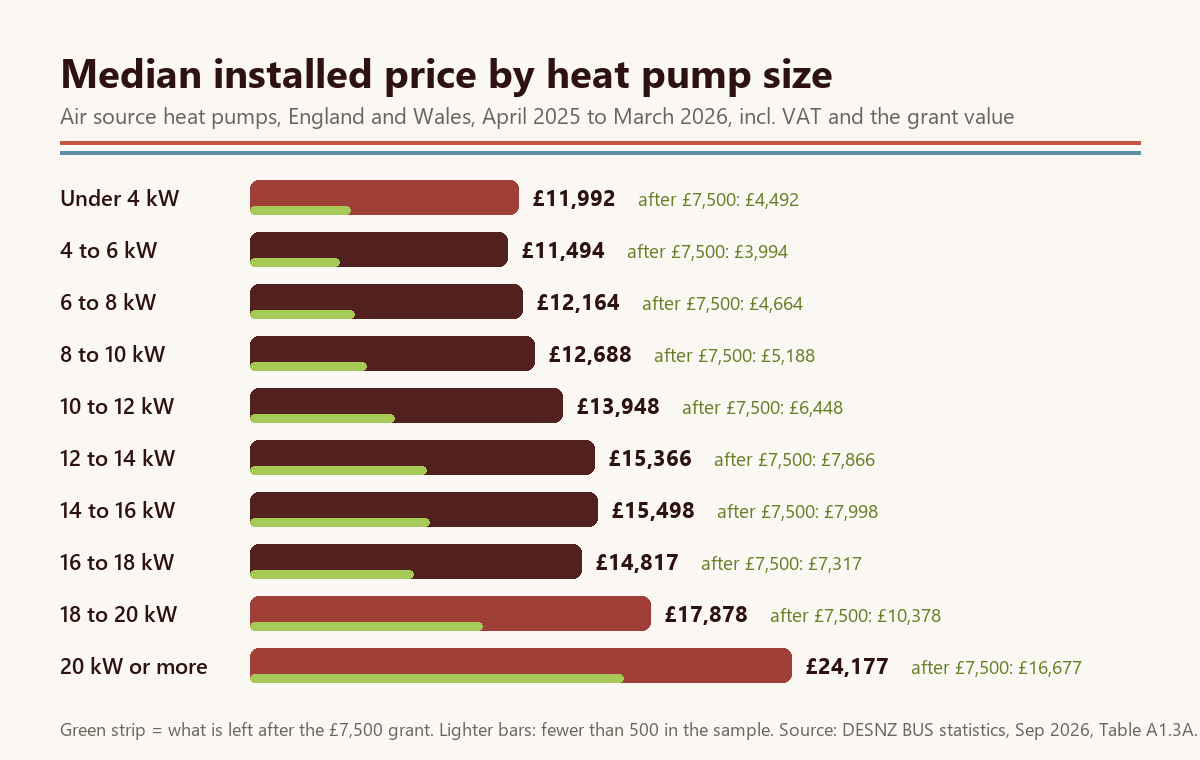
Two homes can pay very different amounts for a heat pump that looks the same from the street. The official figures show why. Across 30,516 grant-funded air source installs from April 2025 to March 2026, the median price climbed with the size of the unit: £12,164 for a 6 to 8 kW system, £13,948 for 10 to 12 kW, and £24,177 for 20 kW or more.
The size is not a choice from a brochure. It comes out of the heat-loss survey, and it pulls other costs along with it. A larger unit usually means more radiators to change, a bigger cylinder and sometimes an upgrade to the electricity supply. A small, well-insulated home may need little beyond the unit, the cylinder and the pipework.
So the number worth comparing is not the headline price, but what is left after the grant for a system sized to your survey. At the all-sizes median of £13,024, that is about £5,524 once £7,500 comes off. Since 28 April 2026 no energy certificate is needed to get the grant, so that step no longer holds a job up.
The installation cost planner on this site shows the median for each size, the grant that applies to your heating and the deadlines that follow from the month you accept a quote.
The scheme clocks
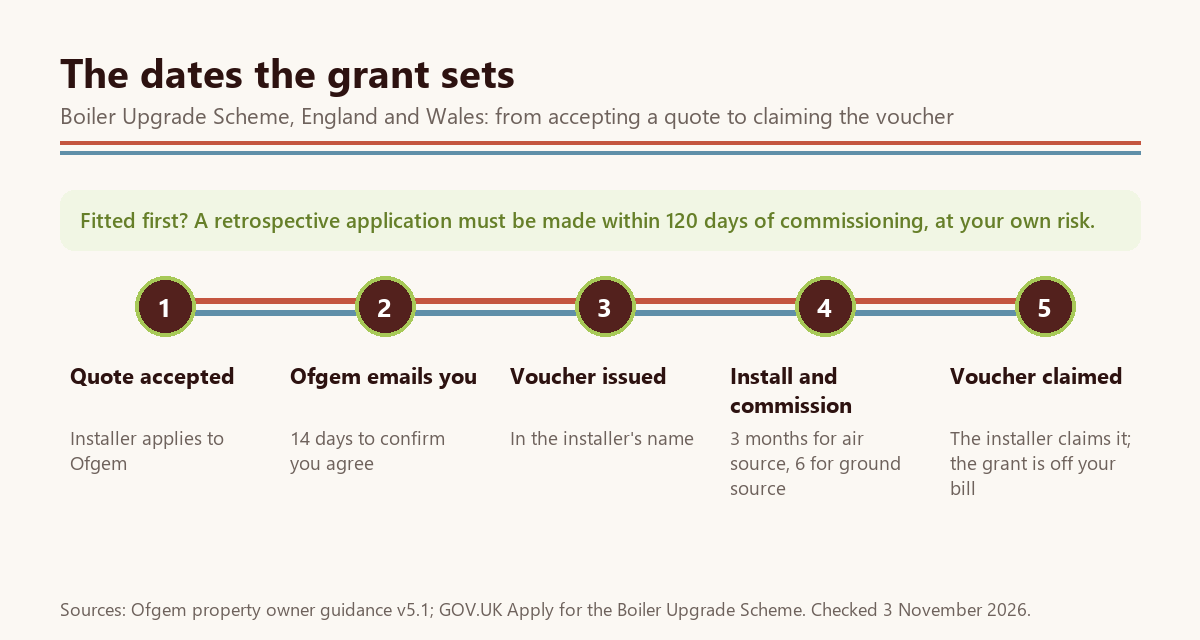
Most installations in England and Wales use the Boiler Upgrade Scheme, and its rules set the order things happen in. Nothing below is a guess about how long an engineer takes: these are the scheme's own limits.
The installer, who must be MCS certified, applies to Ofgem in your name. The grant is shown as a deduction on the quote.
Ofgem emails the property owner to check the installer acts for them. Miss the window and the application can be rejected.
From the voucher being issued, the installer has 3 months to install, commission and claim it. Ground source gets 6 months because of the ground works.
A retrospective application has to be made within 120 days of commissioning, and if it is refused the full cost is yours.
Inside the house
A heat pump replaces the boiler's job, not every part of the heating. Outside, the unit warms water. Inside, that water flows to a hot water cylinder and round the radiators, then returns cooler to be warmed again.
The difference from gas is temperature. A boiler can send water out very hot; a heat pump works best sending it out cooler and for longer. That is why the design flow temperature matters so much, and why some radiators get bigger: they need more surface to give the same heat at a lower temperature. It is also why a combi boiler's instant hot water is usually replaced by a cylinder.
None of this should be guesswork. The radiators and cylinder page shows what to expect and what to ask for on paper.
The planning test
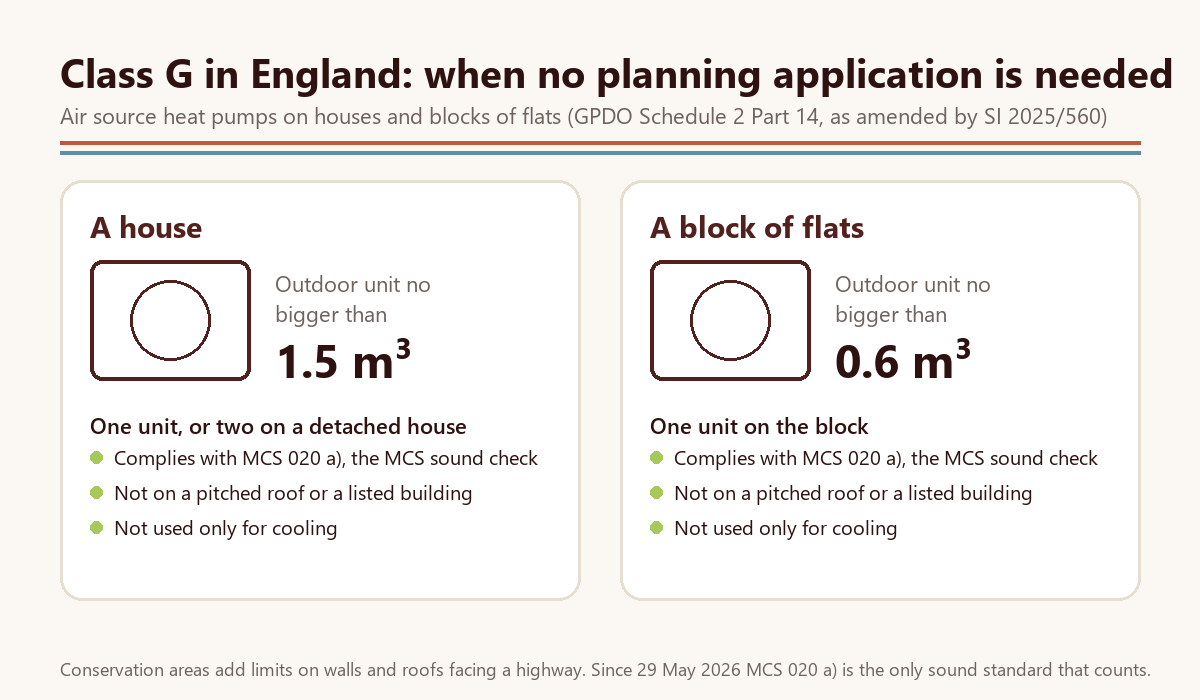
An air source heat pump is permitted development under Class G when every condition is met. The outdoor unit must be no bigger than 1.5 m³ on a house, or 0.6 m³ on a block of flats. A house may have one unit, or two if it is detached; a block of flats only one. It must pass MCS 020 a), the MCS sound check, which since 29 May 2026 is the only standard that counts. It cannot sit on a pitched roof or on a listed building, and it cannot be used only for cooling.
If one condition fails, the answer is a planning application, not a refusal. Conservation areas add limits on walls and roofs facing a road. Ground source heat pumps fall under Class C. Wales has its own rules. The planning permission page works through each check.
This is not a real installation or a quote. It uses only the official figures above to show how the numbers and dates fit together for a three-bedroom house heated by mains gas whose survey calls for an 8 kW heat pump.
| Step | What happens | Figure |
|---|---|---|
| Price for this size | Median for 8 to 10 kW, April 2025 to March 2026 | £12,688 |
| Grant | Owner-occupied, gas boiler replaced, MCS installer | minus £7,500 |
| Left to pay | Before any extra work the survey adds | £5,188 |
| VAT | Installing a heat pump in a home, until 31 March 2027 | 0% |
| Accept quote | Installer applies; you confirm within 14 days | Week 1 to 3 |
| Fit and commission | Inside the voucher's 3 months | By month 3 |
If the same house were heated by oil with no mains gas connection, the grant could be £9,000 instead, but only for an application properly made by 31 March 2027.
At the end of the job
The paperwork is your protection. Ask for it before the final payment, and keep it in one place.
Registered by the installer once the system is commissioned. The grant depends on an MCS certified installation.
The tests, settings and readings taken at switch-on, so a later engineer can see how it was left.
Room-by-room heat loss, the unit's size in kW and the design flow temperature: the numbers the quote was built on.
Installers in a competent person scheme can self-certify the work instead of applying to building control.
Product warranties and workmanship cover. Ofgem lists HIES, RECC and MCS as the consumer codes for the scheme; the RECC code requires at least a two-year workmanship warranty.
Each showing the grant taken off. Ofgem expects the quote to be clear and itemised.
More on each document: commissioning and handover.
Common worries about the work itself
A cylinder needs a cupboard-sized space, often where an old one was before a combi went in. If there is truly no room, raise it at the survey: the design has to say where it goes before you accept.
Not necessarily. The room-by-room heat loss and the flow temperature decide which radiators are big enough already. Ask for the list in writing.
Under permitted development the unit has to pass MCS 020 a), the MCS sound check, and be sited to keep its effect on neighbours to a minimum. Where it is placed matters as much as the model.
The voucher's 3 months (or 6 for ground source) is the hard limit. Agree a schedule that fits inside it before work starts.
Who has these installed
Across every grant-funded heat pump paid out from May 2022 to September 2026, the heating it replaced was:
| Heating replaced | Share of installs |
|---|---|
| Mains gas | 55% |
| Oil | 18% |
| No previous heating | 13% |
| Direct electric | 10% |
| LPG | 3% |
| Coal | 1% |
Source: DESNZ Boiler Upgrade Scheme statistics, Table 1.3. Running costs afterwards depend on your electricity tariff and how efficiently the system is designed to run, which is one more reason to get the design figures in writing. If you are replacing a gas boiler, our guide to swapping a gas boiler for a heat pump covers what changes.
Before you sign
The official benchmark is what installers report for grant-funded jobs. For air source heat pumps installed from July to September 2026 the median was £12,826, and half of all jobs fell between £10,717 and £15,461 (DESNZ). Those prices include VAT and the grant value, so the £7,500 grant most homes can get comes off them: about £5,326 at the median. Your own figure depends on the size your survey calls for and how much work the radiators and cylinder need.
The grant sets most of the timetable. After you accept a quote the installer applies; Ofgem emails you and you have 14 days to confirm. Once the voucher is issued the installer has 3 months to install, commission and claim it for an air source heat pump, or 6 months for ground source. Official sources give no typical number of days on site, so ask each installer for a written schedule.
Often some radiators are enlarged and, if you have a combi boiler, a cylinder is added, because a heat pump heats water more gently than a gas boiler. Which ones change should come from the room-by-room heat-loss figures and the design flow temperature, not from a rule of thumb.
Often not in England. An air source heat pump can be permitted development under Class G if the outdoor unit is no bigger than 1.5 m³ (0.6 m³ on a block of flats), it complies with the MCS 020 a) sound check, it is not on a pitched roof or a listed building, and you have only one (two on a detached house). Conservation areas add limits. Ground source is Class C.
The installer. They must be MCS certified, and they apply on Ofgem's portal. Your part is to confirm within 14 days when Ofgem emails you. The grant is taken off the price on your quote and invoice rather than paid to you.
An MCS certificate, the commissioning record, the heat-loss and design figures, building regulations paperwork, product and workmanship warranties, and instructions for the controls. Keep them together: a buyer of your home, or a future engineer, will ask for them.
Heat Pump and Installation is published by SEO-DONS LTD (company 16766013). It is an information site: it does not fit, survey or sell heat pumps, it holds no accreditation of its own and it is not the government, Ofgem or MCS. Every price on these pages is an official median, not our price, and every rule links to the body that sets it. Questions sent through the form below are read by SEO-DONS LTD and answered by email. More on the about page and in how we check the figures.
Describe the house and where you are in the process: no quote yet, a quote to make sense of, or a voucher already issued. The message goes to SEO-DONS LTD, the company that publishes this guide, and a reply comes back by email.